Poker is a family of card games that combines gambling, strategy and different skills. All poker variants involve betting as an intrinsic part of play, and determine the winner of each hand according to the combinations of players' cards, at least some of which remain hidden until the end of the hand. Poker games vary in the number of cards dealt, the number of shared or 'community' cards, the number of cards that remain hidden, and the betting procedures.
Oct 20, 2017 The latest Tweets from Poker Joker™ (@PokerJokerGear). Minneapolis, MN. The most common meaning of joker is a wild card in poker. There are often two extra joker cards included in a deck of cards. There are often two extra joker cards included in a deck of cards. These cards have no suit, and they traditionally feature a character dressed as a court jester or clown.
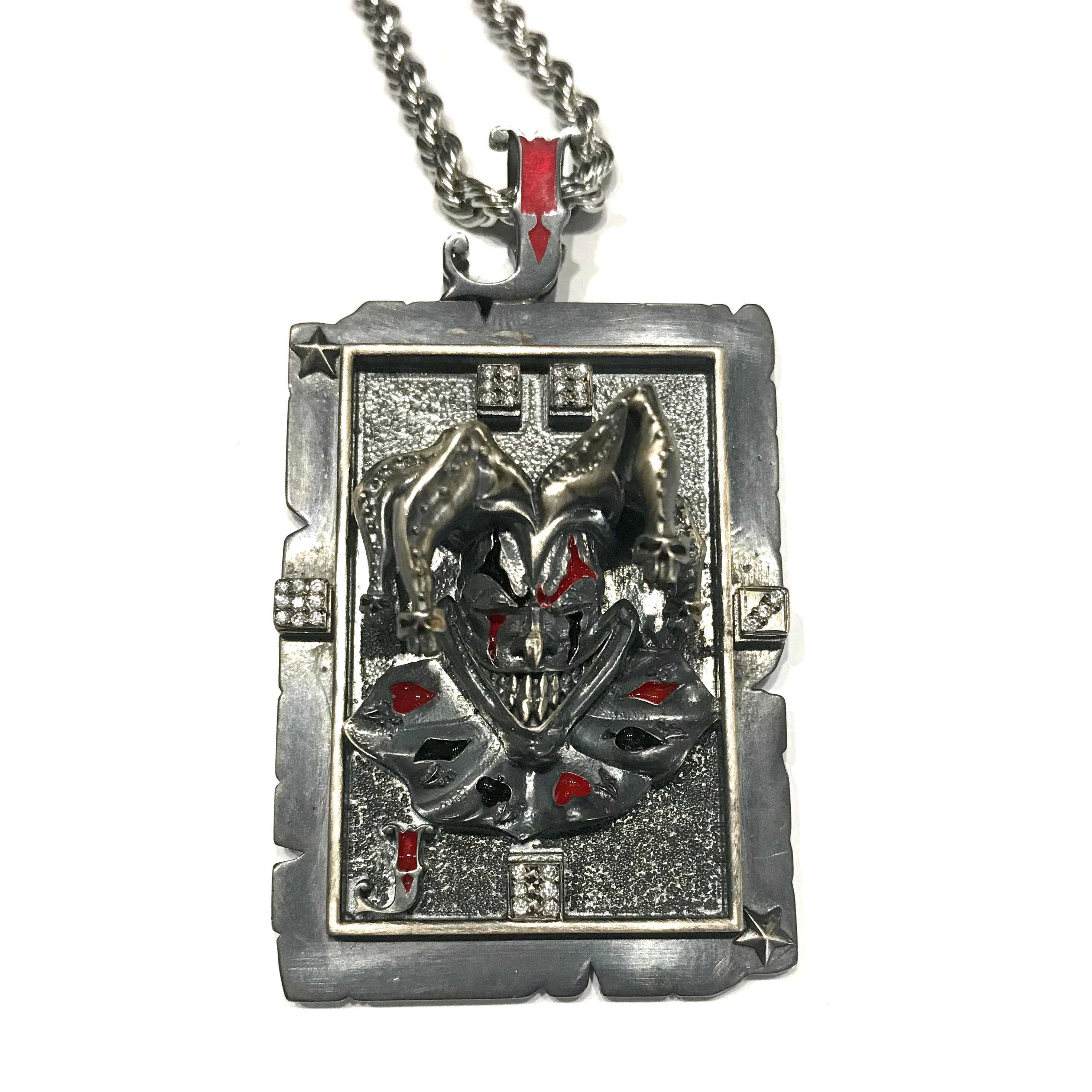
In most modern poker games the first round of betting begins with one or more of the players making some form of a forced bet (the blind or ante). In standard poker, each player bets according to the rank they believe their hand is worth as compared to the other players. The action then proceeds clockwise as each player in turn must either match (or 'call') the maximum previous bet, or fold, losing the amount bet so far and all further involvement in the hand. A player who matches a bet may also 'raise' (increase) the bet. The betting round ends when all players have either called the last bet or folded. If all but one player folds on any round, the remaining player collects the pot without being required to reveal their hand. If more than one player remains in contention after the final betting round, a showdown takes place where the hands are revealed, and the player with the winning hand takes the pot.
With the exception of initial forced bets, money is only placed into the pot voluntarily by a player who either believes the bet has positive expected value or who is trying to bluff other players for various strategic reasons. Thus, while the outcome of any particular hand significantly involves chance, the long-run expectations of the players are determined by their actions chosen on the basis of probability, psychology, and game theory.
Poker has increased in popularity since the beginning of the 20th century and has gone from being primarily a recreational activity confined to small groups of enthusiasts to a widely popular activity, both for participants and spectators, including online, with many professional players and multimillion-dollar tournament prizes.

History[edit]
Poker was developed sometime during the early 19th century in the United States. Since those early beginnings, the game has grown to become an extremely popular pastime worldwide.
In the 1937 edition of Foster's Complete Hoyle, R. F. Foster wrote: 'the game of poker, as first played in the United States, five cards to each player from a twenty-card pack, is undoubtedly the Persian game of As-Nas.' By the 1990s some gaming historians including David Parlett started to challenge the notion that poker is a direct derivative of As-Nas. Developments in the 1970s led to poker becoming far more popular than it was before. Modern tournament play became popular in American casinos after the World Series of Poker began, in 1970.[1]
Gameplay[edit]
In casual play, the right to deal a hand typically rotates among the players and is marked by a token called a dealer button (or buck). In a casino, a house dealer handles the cards for each hand, but the button (typically a white plastic disk) is rotated clockwise among the players to indicate a nominal dealer to determine the order of betting. The cards are dealt clockwise around the poker table, one at a time.
One or more players are usually required to make forced bets, usually either an ante or a blind bet (sometimes both). The dealer shuffles the cards, the player on the chair to his or her right cuts, and the dealer deals the appropriate number of cards to the players one at a time, beginning with the player to his or her left. Cards may be dealt either face-up or face-down, depending on the variant of poker being played. After the initial deal, the first of what may be several betting rounds begins. Between rounds, the players' hands develop in some way, often by being dealt additional cards or replacing cards previously dealt. At the end of each round, all bets are gathered into the central pot.

At any time during a betting round, if one player bets, no opponents choose to call (match) the bet, and all opponents instead fold, the hand ends immediately, the bettor is awarded the pot, no cards are required to be shown, and the next hand begins. This is what makes bluffing possible. Bluffing is a primary feature of poker, one that distinguishes it from other vying games and from other games that make use of poker hand rankings.
At the end of the last betting round, if more than one player remains, there is a showdown, in which the players reveal their previously hidden cards and evaluate their hands. The player with the best hand according to the poker variant being played wins the pot. A poker hand comprises five cards; in variants where a player has more than five cards available to them, only the best five-card combination counts.
Variants[edit]
Poker variations are played where a 'high hand' or a 'low hand' may be the best desired hand. In other words, when playing a poker variant with 'low poker' the best hand is one that contains the lowest cards (and it can get further complicated by including or not including flushes and straights etc. from 'high hand poker'). So while the 'majority' of poker game variations are played 'high hand', where the best high 'straight, flush etc.' wins, there are poker variations where the 'worst hand' wins, such as 'low ball, acey-ducey, high-lo split etc. game variations'. To summarize, there can be variations that are 'high poker', 'low poker', and 'high low split'. In the case of 'high low split' the pot is divided among the best high hand and low hand.
Poker has many variations,[2][3] all following a similar pattern of play[4] and generally using the same hand ranking hierarchy. There are four main families of variants, largely grouped by the protocol of card-dealing and betting:
- Straight
- A complete hand is dealt to each player, and players bet in one round, with raising and re-raising allowed. This is the oldest poker family; the root of the game as now played was a game known as Primero, which evolved into the game three-card brag, a very popular gentleman's game around the time of the American Revolutionary War and still enjoyed in the U.K. today. Straight hands of five cards are sometimes used as a final showdown, but poker is almost always played in a more complex form to allow for additional strategy.
- Stud poker
- Cards are dealt in a prearranged combination of face-down and face-up rounds, or streets, with a round of betting following each. This is the next-oldest family; as poker progressed from three to five-card hands, they were often dealt one card at a time, either face-down or face-up, with a betting round between each. The most popular stud variant today, seven-card stud, deals two extra cards to each player (three face-down, four face-up) from which they must make the best possible 5-card hand.
- Draw poker
- A complete hand is dealt to each player, face-down, and after betting, players are allowed to attempt to change their hand (with the object of improving it) by discarding unwanted cards and being dealt new ones. Five-card draw is the most famous variation in this family.
- Community card poker
- Also known as 'flop poker', community card poker is a variation of stud poker. Players are dealt an incomplete hand of face-down cards, and then a number of face-up community cards are dealt to the center of the table, each of which can be used by one or more of the players to make a 5-card hand. Texas hold 'em and Omaha are two well-known variants of the community card family.
Wild Joker Poker
There are several methods for defining the structure of betting during a hand of poker. The three most common structures are known as 'fixed-limit', 'pot-limit', and 'no-limit'. In fixed-limit poker, betting and raising must be done by standardized amounts. For instance, if the required bet is X, an initial bettor may only bet X; if a player wishes to raise a bet, they may only raise by X. In pot-limit poker, a player may bet or raise any amount up to the size of the pot. When calculating the maximum raise allowed, all previous bets and calls, including the intending raiser's call, are first added to the pot. The raiser may then raise the previous bet by the full amount of the pot. In no-limit poker, a player may wager their entire betting stack at any point that they are allowed to make a bet. In all games, if a player does not have enough betting chips to fully match a bet, they may go 'all-in', allowing them to show down their hand for the amount of chips they have remaining.
Other games that use poker hand rankings may likewise be referred to as poker. Video poker is a single-player video game that functions much like a slot machine; most video poker machines play draw poker, where the player bets, a hand is dealt, and the player can discard and replace cards. Payout is dependent on the hand resulting after the draw and the player's initial bet.
Strip poker is a traditional poker variation where players remove clothing when they lose bets. Since it depends only on the basic mechanic of betting in rounds, strip poker can be played with any form of poker; however, it is usually based on simple variants with few betting rounds, like five card draw.
Another game with the poker name, but with a vastly different mode of play, is called Acey-Deucey or Red Dog poker. This game is more similar to Blackjack in its layout and betting; each player bets against the house, and then is dealt two cards. For the player to win, the third card dealt (after an opportunity to raise the bet) must have a value in-between the first two. Payout is based on the odds that this is possible, based on the difference in values of the first two cards. Other poker-like games played at casinos against the house include three card poker and pai gow poker.
Computer programs[edit]
A variety of computer poker players have been developed by researchers at the University of Alberta, Carnegie Mellon University, and the University of Auckland amongst others.
In a January 2015 article[5] published in Science, a group of researchers mostly from the University of Alberta announced that they 'essentially weakly solved' heads-up limit Texas Hold 'em with their development of their Cepheus poker bot. The authors claimed that Cepheus would lose at most 0.001 big blinds per game on average against its worst-case opponent, and the strategy is thus so 'close to optimal' that 'it can't be beaten with statistical significance within a lifetime of human poker playing'.[6]
See also[edit]
References[edit]
- ^'World Series of Poker Retrospective: Horseshoe History'. gaming.unlv.edu. Retrieved 2019-01-13.
- ^Richard D. Harroch, Lou Krieger. Poker for Dummies. John Wiley & Sons, 2010
- ^Reuben, Stewart 2001. Starting out in Poker. London: Everyman/Mind Sports. ISBN1-85744-272-5
- ^Sklansky, David. The Theory of Poker. Two Plus Two Pub, 1999.
- ^Bowling, M.; Burch, N.; Johanson, M.; Tammelin, O. (2015). 'Heads-up limit hold'em poker is solved'(PDF). Science. 347 (6218): 145–149. CiteSeerX10.1.1.697.72. doi:10.1126/science.1259433. PMID25574016.
- ^Computer program 'perfect at poker' (2015-01-08), BBC
External links[edit]
| Wikibooks has a book on the topic of: poker |
| Wikiquote has quotations related to: Poker |
| Look up poker in Wiktionary, the free dictionary. |
| Wikimedia Commons has media related to Poker. |
- Poker at Curlie
Seven-Card Stud and Texas Hold’em are the two most popular forms of Poker in which the highest ranking hand wins. These games are played with a 52-card deck — there is no joker — composed of four suits: spades, hearts, diamonds, and clubs.
Each suit is equal in value, and there are 13 ranks in each suit. The ace is the highest ranking card in a suit, followed by king, queen, jack, and 10 through 2 (or deuce), in descending order. An ace may also be used as the lowest ranking card in a 5-high straight (5-4-3-2-A), which is also called a wheel or bicycle.
Although Stud and Hold’em are played with seven cards, the best hand refers to the best five-card hand. Hand rankings are a function of probability. The rarer the hand, the more valuable it is. See the figure for an at-a-glance look at hand ranking in descending value.
Royal flush; straight flush
A royal flush is simply an ace-high straight flush and is the best possible hand in Poker. There are only four of them: Ace through ten of each suit.
A straight flush is any five cards of the same suit in sequence, such as the 9 through 5 of hearts or the queen through 8 of diamonds.
Four-of-a-kind
Four-of-a-kind, or quads, is a five-card hand composed of all the cards of one rank, plus one unrelated card. The higher the rank, the better the hand. For example, four kings beats four jacks.
Full house
Three cards of one rank and a pair of another make a full house. The rank of the full house is determined by the three-card grouping, not the pair. A hand like three 9s and two 5s is referred to as “nines full of fives.”
Flush
A flush is any five cards of the same suit. The cards are not in sequence. If they were in sequence, it would be a straight flush. If there is more than one flush, the winning hand is determined by the rank order of the highest card, or cards, in the flush. A flush composed of the ace, queen, jack, and 6 and 5 of hearts is higher than an ace, queen, jack, and 4 and 3 of spades.
Straight
Five sequenced cards, not all of the same suit, compose a straight. If more than one straight is present, the highest card in the sequence determines the winning hand. A jack-high straight of the jack through 7 of diamonds will beat a 9 through 5 of spades nine-high straight.
Three-of-a-kind
Three cards of the same rank, along with two unrelated cards is called three-of-a-kind. This hand is also referred to as trips, or a set. If you held three 8s, a king, and a 4 you could refer to it as “trip 8s” or “a set of 8s.”
Two pair
Two cards of one rank along with two cards of another rank and one unrelated card composes two pair. The higher rank determines which two pair is superior. If two players hold two pair and each has the same high pair, then the rank of the second pair determines the winner. If both players hold the same two pair, then the rank of the unrelated side card determines the winning hand. If the hand is identical, then the players split the pot. For example, queens and 8s is superior to queens and 5s.
One pair
Poker Is Joker With A J T
One pair is simply two cards of one rank and three unrelated cards. If two players hold the same pair, then the value of the unrelated side cards determines the winning hand.
No pair
Poker Is Joker With A J
No pair consists of five unrelated cards. When no player has a pair, then the rank order of the unrelated cards determines the winning hand. For example, if Harry has A-Q-9-6-3 and Adrien has A-J-10-3-2, then Harry wins because A-Q ranks higher than A-J.
Low hands
Poker Is Joker With A J White
In split-pot games, like Omaha/8, the best low hand composed of five unrelated cards with the rank of 8 or lower, captures half the pot. A hand like 7-6-4-3-A beats 7-6-5-3-A, but will lose to 7-4-3-2-A.
Determining the best low hand takes a bit of practice, but if you always begin with the highest of the low cards and continue in descending order, you can’t go wrong.